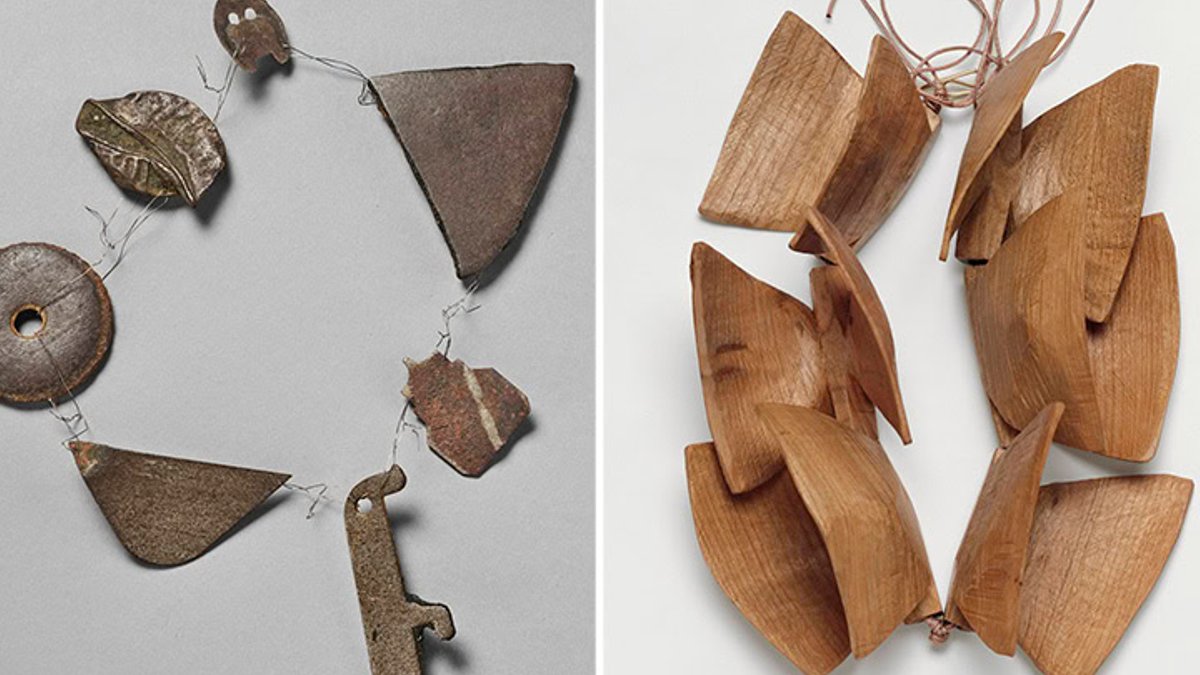
The Museum of Fine Arts, Houston is presenting concurrent retrospectives of two jewelry artists who came of age on opposite sides of a divided Europe, marking their first U.S. solo exhibitions. Going Underground: The Jewels of Bernhard Schobinger and The Jewelry of Dorothea Prühl will run through January 3, 2027, offering visitors a rare chance to compare two distinct approaches to contemporary jewelry.
Contrasting Visions in Metal and Wood
Bernhard Schobinger, born in Zurich in 1946, emerged from Switzerland’s postwar avant-garde scene, studying at the city’s School of Applied Arts and drawing early inspiration from Concrete Art. His work shifted dramatically in the 1970s when he adopted the international punk movement, incorporating found materials like broken glass, saw blades, and metal pried from city streets. A self-described “human paradox,” Schobinger pairs rigorous Swiss goldsmithing techniques with unconventional materials, guided philosophically by Paul Feyerabend, whose 1975 book Against Method challenged the idea of fixed rules in science.
Dorothea Prühl, born in 1937 in what is now Wrocław, Poland, developed her practice behind the Iron Curtain in East Germany. After training at Burg Giebichenstein in Halle, she became a influential teacher at the same institution. Unlike Schobinger’s politically charged environment, Prühl focuses inward, creating jewelry that explores form, sound, and the emotional experience of wearing art. Her work spans carved wood, titanium, and other metals, with each piece reflecting deep consideration of how materials embody form and feeling.
Read Also: Jürgen Eickhoff presents Networks exhibition at Galerie V&V
The exhibitions came together through the Museum’s acquisition of the Rotasa Collection Trust, which houses the largest collection of Prühl’s jewelry in the United States alongside significant holdings of Schobinger’s work. Co-curators Cindi Strauss and Elizabeth Essner recognized the opportunity to create a dialogue between two artists whose practices, while aesthetically different, share singular dedication to craft and the influence of place and personal experience.
Visitors will find the shows installed side by side, encouraging comparison of two artists who each expanded jewelry’s possibilities in their own way. Schobinger’s NYC 1980 necklace incorporates metal literally pried from West Broadway asphalt, suggesting both amulet and armor with nearly invisible wire connections that barely hold the piece together. Prühl’s Flowers from Augustenberg (1989) honors her rural youth through a garland of carved wood flowers, created in a forest workshop three hours north of her Halle studio where she works alone in a farmhouse with no running water.
Dialogue Across Divided Europe
The co-curators noted that placing the two artists in conversation required careful attention to their contrasting rhythms. Schobinger’s process thrives on urgency, often working through the night in Zurich’s underground clubs, while Prühl’s pace follows the slow growth of timber and the seasons of her forest workshop. Their shared commitment to craft emerges through these opposing tempos.
Read Also: Diamond industry divided over naming lab-grown stones
Material Stories and Cosmic Connections
Schobinger’s Meteor Iron Ring (1993) embeds a fragment of extraterrestrial matter within a band forged from terrestrial metals. The piece bridges personal adornment with universal time, reflecting his interest in Feyerabend’s critique of rigid methodologies. Each material choice serves as a philosophical statement rather than mere decoration.
Prühl’s wooden carvings originate from trees already fallen in the Thuringian Forest. She selects each branch based on its natural curves and grain patterns, allowing the wood’s inherent character to guide the final form. Her pieces often take months to complete, as she waits for inspiration to align with the material’s readiness.


