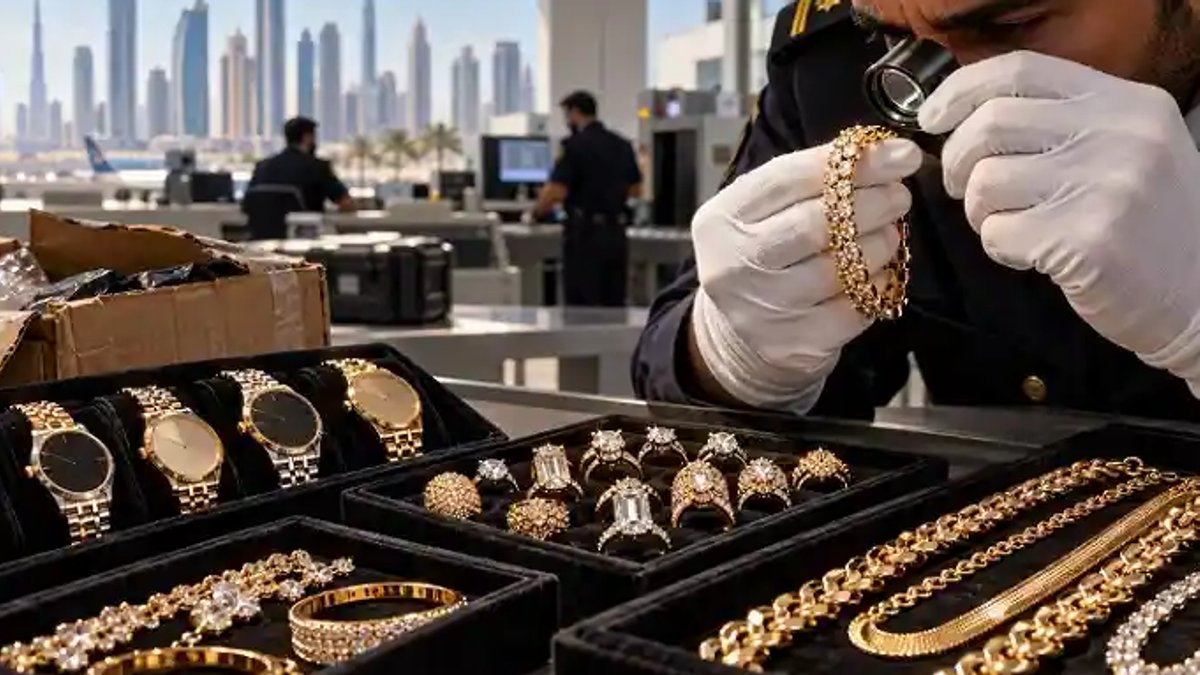
The Middle East faces a worsening crisis of counterfeit jewelry and luxury watches, as enforcement gaps allow billions in fake goods to flood markets. The global trade in counterfeit and pirated products hit $467 billion in 2021, according to an OECD and European Union Intellectual Property Office report, yet regional authorities cannot track how much enters Arab markets or its sources. Customs seizures only show part of the picture.
In the U.S., $7.4 billion worth of counterfeit goods were seized in fiscal year 2025, with jewelry alone valued at $3.2 billion. These numbers represent only detected shipments, not the full market. Small packages, often disguised as personal deliveries, evade detection. In June 2026, Louisville International Airport intercepted a single shipment containing 375 counterfeit Audemars Piguet watches worth over $54 million at retail prices.
China and Hong Kong control 84% of the supply chain for fake Swiss watches, accounting for 84% of seized goods’ value in 2020 and 2021. The OECD estimates counterfeit watches cost the Swiss watchmaking industry $1.88 billion in lost sales in 2021—40% of total intellectual property damage. Beyond revenue losses, the sector lost 2,537 jobs, or 4.5% of its workforce.
Online platforms worsen the problem. TikTok removed 40 million products before listing in early 2025 for intellectual property violations, followed by 2 million more after they appeared. The platform also deleted 143 million videos promoting counterfeit goods and 530,000 creator videos tied to infringements. These actions span multiple product categories, showing how digital marketing fuels demand before goods reach customs.
Counterfeit trade fuels organized crime networks
Counterfeit operations increasingly connect to organized crime. A 2024 Europol-backed operation in Belgium, Israel, the Netherlands, and Slovakia exposed links between luxury watch counterfeiting, drug trafficking, and money laundering. Authorities seized 165 counterfeit watches, 200 diamonds, €209,000 in cash, 14 kilograms of drugs, and cryptocurrency records. The watches were assembled outside the EU using a mix of genuine and fake parts, then imported into Belgium for distribution.
Middle Eastern markets lack coordinated tracking. Dubai Customs recorded 285 seizures worth AED 92.695 million in 2024, but Morocco’s 2025 data did not separate jewelry from other goods. Egypt and Saudi Arabia have not released recent figures isolating counterfeit jewelry or watches, leaving enforcement fragmented. Without a shared database tracking shipment origins, routes, and valuation methods, authorities cannot piece together a full regional picture.
The issue extends beyond high-end brands. In August 2026, officials in Indianapolis intercepted a Hong Kong shipment bound for Georgia containing 875 counterfeit jewelry pieces, including Cartier, Tiffany & Co., and Van Cleef & Arpels, with a genuine retail value exceeding $3.7 million. The shipment was split into small parcels, a tactic that makes large-scale seizures harder to detect.
Luxury watches drive billions in lost sales
Watches made up 23% of the total value of seized counterfeit goods worldwide between 2020 and 2021, surpassing footwear at 15%. This share reflects the high retail value of luxury timepieces, even when copied.
In the U.S., Customs and Border Protection intercepted 25,079 shipments of counterfeit goods in fiscal year 2025, involving 78.4 million items with an estimated retail value of $7.4 billion. Jewelry led seizures by value at $3.2 billion, followed by watches at $1.5 billion. Handbags and wallets made up $978 million. These figures show how counterfeit luxury goods dominate high-value seizures, though they represent only a fraction of what evades detection.
Morocco’s customs data for 2025 included 896,000 goods involved in release suspensions, valued at MAD 11.1 million, but did not isolate jewelry or watches.


