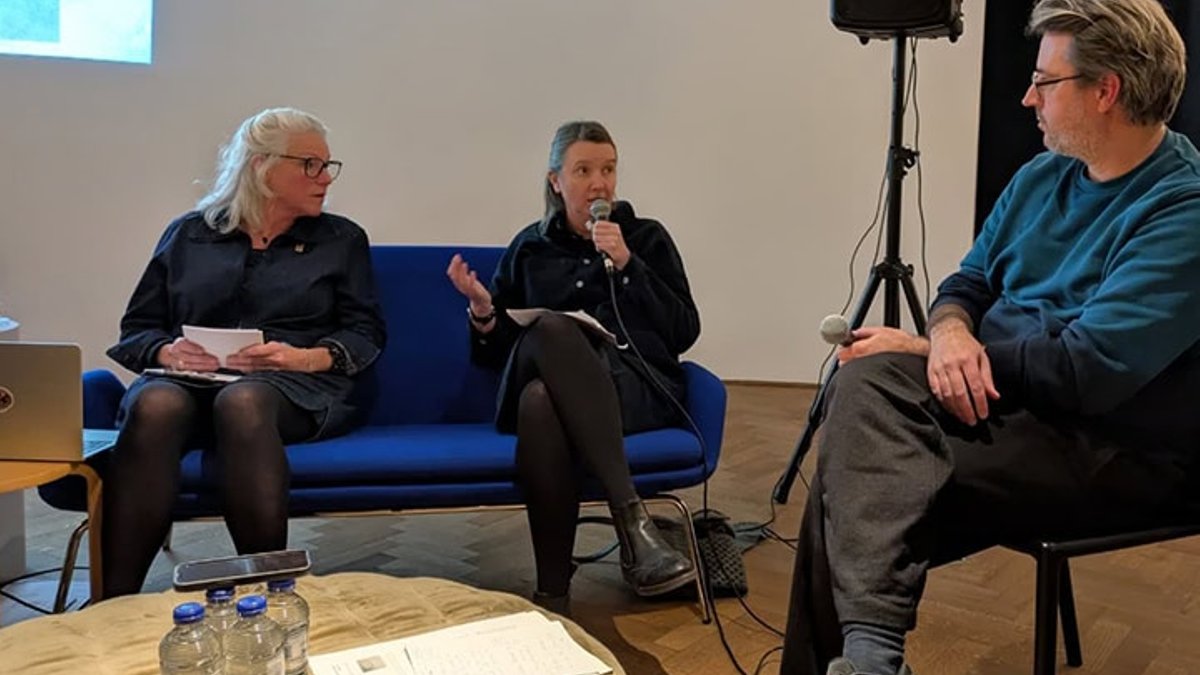
The open call has become a defining feature of modern jewelry exhibitions, promising equal opportunity, artistic discovery, and a fair competitive platform. Yet beneath this democratic facade lies a system where artists bear disproportionate administrative, financial, and emotional costs, while organizers enjoy operational efficiency and minimal overhead. These tensions came to light during a roundtable discussion held in Antwerp last November, where artists, curators, and exhibition organizers clashed over the true expenses of participating in open calls.
The event opened with a visual critique by art historian Saskia van Es. She presented Open Calls, an installation by Ana Escobar Saavedra. The piece consists of a glass cube engraved with phrases taken directly from open call guidelines. We read statements such as “Work must fit in 30 x 30 x 30 centimetres,” “We only exhibit wearable jewelry,” and the familiar “Applicants must be under 35.” The work functions as an almost perfect metaphor for the open-call system itself. The words are trapped inside the glass cube, with barely enough room to breathe.
The second part of Escobar’s installation reproduces the standard rejection email sent for years by the organizers of Schmuck, in Munich: “Dear Artist, we are sorry to inform you that your work was not selected for Schmuck [fill in the year],” followed by a polite invitation to nevertheless travel to Munich. Rejection becomes routine: an automated form of politeness that suggests proximity while producing distance. A bitter laugh moved through the audience during this part of the conversation. Most artists have learned to accept rejection as part of professional life.
Read Also: Houston Museum Presents Schobinger and Prühl Jewelry Retrospectives
Age Limits Exclude More Than They Include
Age restrictions emerged as a key point of contention. Curator Ebba Van der Taelen observed that such limits, framed as support for “emerging” talent, actually exclude many artists who begin their careers later in life, return to practice after decades away, or only gain access to education and resources much later. What is intended as a form of support can easily become a form of exclusion.
For artists like Into Niilo, the open call season—peaking in October and November—feels less like an opportunity and more like a high-stakes gamble. Niilo described the process as a marathon of unpaid labor: compiling portfolios, writing artist statements, paying application fees, and sometimes covering travel costs even before submission. This metaphor evokes an image of artists throwing bottles into the ocean in the hope that someone might respond.
Yet Niilo’s description also makes clear that this “gambling” reflects a real situation. Artists often pay application fees, transport costs, and insurance. Some must also cover travel and accommodation expenses once selected because they are expected to be present. All of this comes on top of the unpaid labor involved in preparing portfolios, statements, photographs, and application forms. As a result, much of the risk shifts from the organizer to the artist.
Artists Bear Costs, Organizers Gain Efficiency
The financial burden does not end with applications. Many open calls demand that artists produce new work, ship it to exhibitions, and sometimes insure it—all without assurances of visibility, sales, or compensation. For organizers, this model is highly efficient: a single call can generate hundreds of submissions with limited means. But for artists, participation often feels like an investment with no clear return. Liesbet Bussche, a jewelry artist and panelist, criticized the format for reducing exhibitions to “one-piece shows,” where a single object must represent an entire artistic practice. Jewelry concerns stories, yet the exhibition presents the object stripped of its narrative. The open call risks becoming
Read Also: Jürgen Eickhoff presents Networks exhibition at Galerie V&V
The discussion revealed two conflicting perspectives on open calls: one views them as a democratic tool for artistic discovery, while the other sees them as a system that shifts financial and emotional risks onto artists while offering organizers a low-cost solution. As moderator Saskia van Es framed it, the question remains whether true openness can exist without transparency, or whether the term has become little more than a marketing strategy.
Open Calls Hide Vastly Different Hidden Rules
A particularly revealing moment occurred when participants compared two distinct open call models: WearHouse in Amsterdam and the Montebello Award in Italy. WearHouse operated as a curated group exhibition with clear thematic boundaries, while the Montebello Award functioned as a competitive prize. This contrast highlighted how the term “open call” now encompasses vastly different formats, exhibitions, prizes, residencies, and festivals, each with its own expectations and economic implications. What unites them, however, is the lack of clarity about who bears the costs of participation.
Tom Iriks, a curator who moderated the discussion, emphasized that the issue lies not in the open call format itself but in how it has become a default solution for structural shortages of time and resources. “I’m quite a fan of the open call format, if it’s done well,” he said. The core problem, according to Iriks, is that openness without accountability creates confusion rather than accessibility. Artists face vague criteria, hidden fees, and the emotional toll of rejection, while organizers benefit from the appearance of inclusivity without addressing the underlying inequities.


