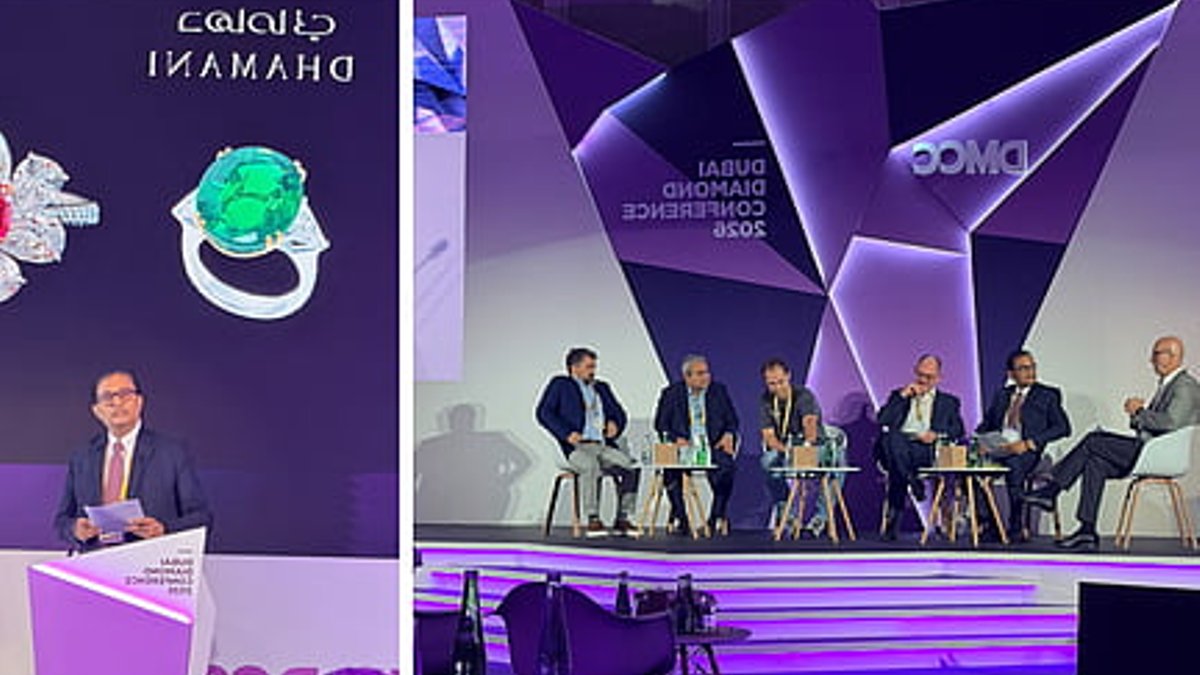
The Dubai Diamond Conference 2026 explored the potential of tokenization to address challenges in the diamond industry. Panel 5, moderated by Neil Ventura, Special Advisor, Precious Stones, DMCC, discussed two approaches to tokenization: fractional ownership of individual certified diamonds and a digital unit backed by a diversified pool of natural diamonds.
Amit Dhamani of Dhamani Jewels Group presented a model for fractional ownership, using a $1 million red diamond as an example. The model would allow investors to purchase digital tokens representing a share of the diamond, with smart contracts recording ownership and transfers. The proposed launch would begin with smaller stones, investor funds held in escrow and provisions to return the money if something went wrong. “We would rather prove it carefully than scale it carelessly,” he said.
Martin Leake of Martin Leake FZCO outlined a similar model, developed with technology firm Ctrl Alt and Billiton Diamond. The initiative aims to address the pressure on manufacturers who pay upfront for rough diamonds and the difficulty investors face in assessing a diamond’s investment value.
Fractional Ownership Models
Ilya Shichanin of Ctrl Alt drew parallels with the company’s work on tokenizing title deeds for the Dubai Land Department. He argued that diamonds share characteristics with real estate, including uniqueness and illiquidity.
Jamal Akhtar of Billiton Diamond highlighted the commercial opportunity for businesses holding exceptional stones and investors seeking exposure without committing to a single diamond. He described tokenization as “the second engine of growth for our industry.”
Alternative Approach: Diamond-Backed Currency
Daniel Wolfe of Facent Open Market Administration presented a different proposition, introducing Facet, a digital unit backed by a large, diversified pool of natural diamonds held in trust. Unlike fractional ownership models, Facet would not represent a share in an individual stone.
Related Post: Diamond industry faces financial pressure
Wolfe argued that financial markets had yet to develop pooled investment structures for diamonds, similar to those created for commercial property in the 1980s. He also questioned the backing of several crypto assets and argued that stablecoins can leave holders carrying risk while issuers retain the returns.
The Facet model would issue new units only as diamonds were acquired, making it a “rules-based, price-disciplined, long-hold buyer” for the trade. The portfolio would respond to end-consumer demand, and certificates, images, and 3D videos would be recorded on-chain.
Wolfe said that for 4,000 years, diamonds have been collateral. They’ve never been money.
The discussion revealed that both approaches face similar challenges, including liquidity, pricing, regulation, and exit mechanisms. Amit Dhamani noted that tokenizing an asset does not automatically make it liquid, and Martin Leake emphasized the need for credible, independent valuations.
Clear exit mechanisms are essential for investor confidence, and Martin Leake’s proposed buy-out auction and Facet’s proposed buy-back below a specified price band offer different approaches to providing investors with an exit route. Jamal Akhtar emphasized the importance of transparency in the ecosystem, including independent valuations, accountability from supplier to custodian, and upfront disclosure of conflicts.
Building Trust and Transparency
Ilya Shichanin cautioned against overstating the technology’s capabilities, noting that tokenization would not create a spot price for diamonds but could make ownership records more reliable. Daniel Wolfe stressed that Facet is not a stablecoin or a tokenized inventory product, but rather a new way to invest in diamonds.


