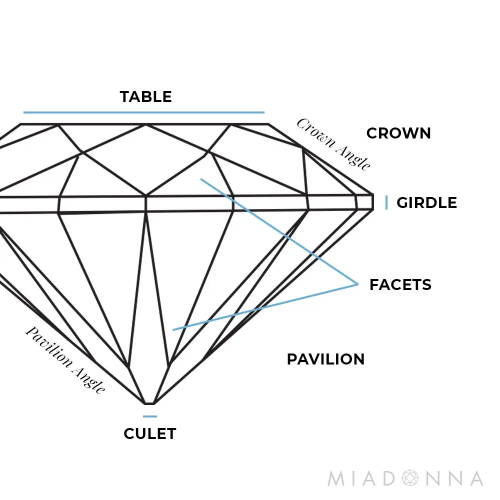
Diamonds have captivated human imagination for centuries, not only because of their brilliance and allure but also due to the intricate processes that bring them to life. Beneath their captivating exterior lies a meticulous structure—an anatomy shaped by both nature’s forces and the hands of expert craftsmen. Understanding the anatomy of a diamond is a journey into a world of precise geometry, sophisticated cutting techniques, and an unparalleled interplay of light and form. This study of precision reveals the factors that elevate a diamond from a mere stone to an extraordinary work of art and a symbol of rarity and perfection.
The Structure: The Crystal Lattice of Perfection
At the core of every diamond lies its crystal structure, an unyielding framework that distinguishes it from all other gemstones. Unlike softer minerals that form in layered or irregular structures, a diamond’s atoms are arranged in a rigid, three-dimensional lattice. This crystalline arrangement is what gives diamonds their remarkable hardness—rated as 10 on the Mohs scale, the highest possible rating for any substance.
Each carbon atom in a diamond is covalently bonded to four neighboring carbon atoms in a tetrahedral shape. This arrangement forms an extremely strong and stable structure, resulting in a material that can withstand immense pressure and is virtually indestructible under normal conditions. It is the crystalline structure of a diamond that allows light to be refracted and reflected in ways that create its signature brilliance.
The Cut: The Artisan’s Touch
While a diamond’s natural formation is impressive in its own right, it is the cut that truly defines its beauty and character. The cut refers not to the shape of the diamond, but to how the stone has been shaped and faceted to optimize its ability to reflect and refract light. It is this facet that determines whether a diamond sparkles like a star or appears dull and lifeless.
There are several common cuts, each of which brings out different qualities in the diamond. The most iconic is the brilliant cut, characterized by its numerous facets that maximize the stone’s light return. The brilliant cut typically features 57 or 58 facets, arranged in a precise configuration to create a symmetrical and harmonious shape. Other cuts, such as the emerald cut, princess cut, or cushion cut, emphasize different aspects of the diamond’s character, whether it’s a larger surface area, a square or rectangular shape, or a more rounded, vintage appearance.
The skill and precision required in cutting a diamond cannot be overstated. A single miscalculation during the cutting process can result in a significant loss of brilliance and value. The cutter must strike a delicate balance between maximizing the stone’s potential and preserving as much of the original rough diamond as possible. It is a process that requires both technical expertise and an intuitive understanding of how light interacts with the stone.
The Four Cs: A Comprehensive Evaluation of Diamond Quality
The anatomy of a diamond is more than just its physical structure; it is also defined by a set of characteristics that determine its quality and value. The “Four Cs”—cut, color, clarity, and carat weight—are the key factors used to evaluate a diamond’s overall quality. These elements work in concert to create a diamond that is both visually stunning and structurally sound.
- Cut: As previously discussed, the cut is perhaps the most important factor in determining a diamond’s brilliance. It dictates how light is reflected and refracted through the diamond, contributing to its sparkle and fire.
- Color: Diamonds come in a range of colors, from completely colorless to shades of yellow or brown. The less color a diamond has, the more valuable it is considered. This is because colorless diamonds allow light to pass through more easily, enhancing their brilliance. The color grading scale for diamonds ranges from D (colorless) to Z (light yellow or brown).
- Clarity: Clarity refers to the presence of internal or external imperfections known as inclusions and blemishes. These imperfections can impact the diamond’s overall appearance and value. While many diamonds contain small inclusions that are visible only under magnification, the fewer inclusions a diamond has, the more valuable it is considered. Diamonds with flawless clarity are incredibly rare and command a premium price.
- Carat Weight: Carat weight is a measure of a diamond’s size, with one carat equivalent to 0.2 grams. While larger diamonds are generally more valuable, the relationship between carat weight and price is not linear. A larger diamond with excellent cut, color, and clarity will often fetch a higher price per carat than a smaller diamond with poorer qualities.
When these four elements are expertly balanced, they create a diamond that is as aesthetically pleasing as it is rare. The precision with which each characteristic is evaluated ensures that no two diamonds are exactly alike, contributing to the unique nature of each gem.
The Facets: Geometry at Its Finest
One of the most fascinating aspects of diamond anatomy is the role that facets play in determining a diamond’s brilliance. A facet is a flat surface cut into a diamond that reflects light. The more facets a diamond has, the greater its ability to capture and reflect light, resulting in greater sparkle.
In a well-cut brilliant diamond, there are 57 or 58 facets, each of which has a specific purpose in reflecting light in the most optimal way. These facets are precisely positioned to reflect light back through the top of the diamond, creating the signature sparkle that makes diamonds so irresistible. The arrangement of facets is also what creates the diamond’s “fire,” the dispersion of light into various colors that adds to its visual appeal.
The most important facets in a diamond’s anatomy are the crown (the top portion of the diamond) and the pavilion (the lower portion). The proportions and angles of these facets influence how light interacts with the diamond, determining its overall brilliance and fire. If the facets are cut too shallow or too deep, light may escape from the sides or bottom of the diamond, reducing its brilliance. It is the precision of these facets that allows a diamond to shine with unparalleled intensity.
The Shape: Defining a Diamond’s Identity
While the cut refers to the precision of the facets, the shape of a diamond is a defining characteristic that plays a significant role in its overall appearance. The shape is the external form of the diamond and can vary widely, from classic round diamonds to more unique shapes like oval, pear, and marquise.
The round shape, known as the round brilliant cut, is by far the most popular and widely recognized, accounting for the majority of diamonds sold worldwide. Its symmetrical form allows for maximum light reflection, resulting in exceptional brilliance. Other shapes, such as the princess cut, which is square or rectangular with sharp corners, or the emerald cut, which features long, rectangular facets, offer a distinctive look while still allowing for significant light play.
The shape of a diamond is a matter of personal preference, yet it also impacts the diamond’s visual properties. Some shapes, like the round brilliant cut, have a greater capacity for brilliance, while others, like the emerald cut, offer a more understated elegance. The choice of shape is integral to the overall aesthetic of the diamond and is often chosen to complement the wearer’s style or the design of the jewelry in which it is set.
The Final Product: A Jewel of Precision and Craftsmanship
The anatomy of a diamond is a masterpiece of precision, from its internal crystal structure to its carefully cut facets. It is a perfect fusion of nature’s geological forces and the skill of human craftsmanship. Whether as an investment, an heirloom, or a symbol of love, a diamond represents the pinnacle of fine jewelry, a creation that is as much about artistry as it is about science.
Each diamond is unique, with its own combination of color, clarity, cut, and carat weight, making it a precious and highly sought-after gem. It is the sum of these elements, brought together with meticulous care and precision, that elevates a diamond to its status as one of the most treasured and revered gemstones in the world.


